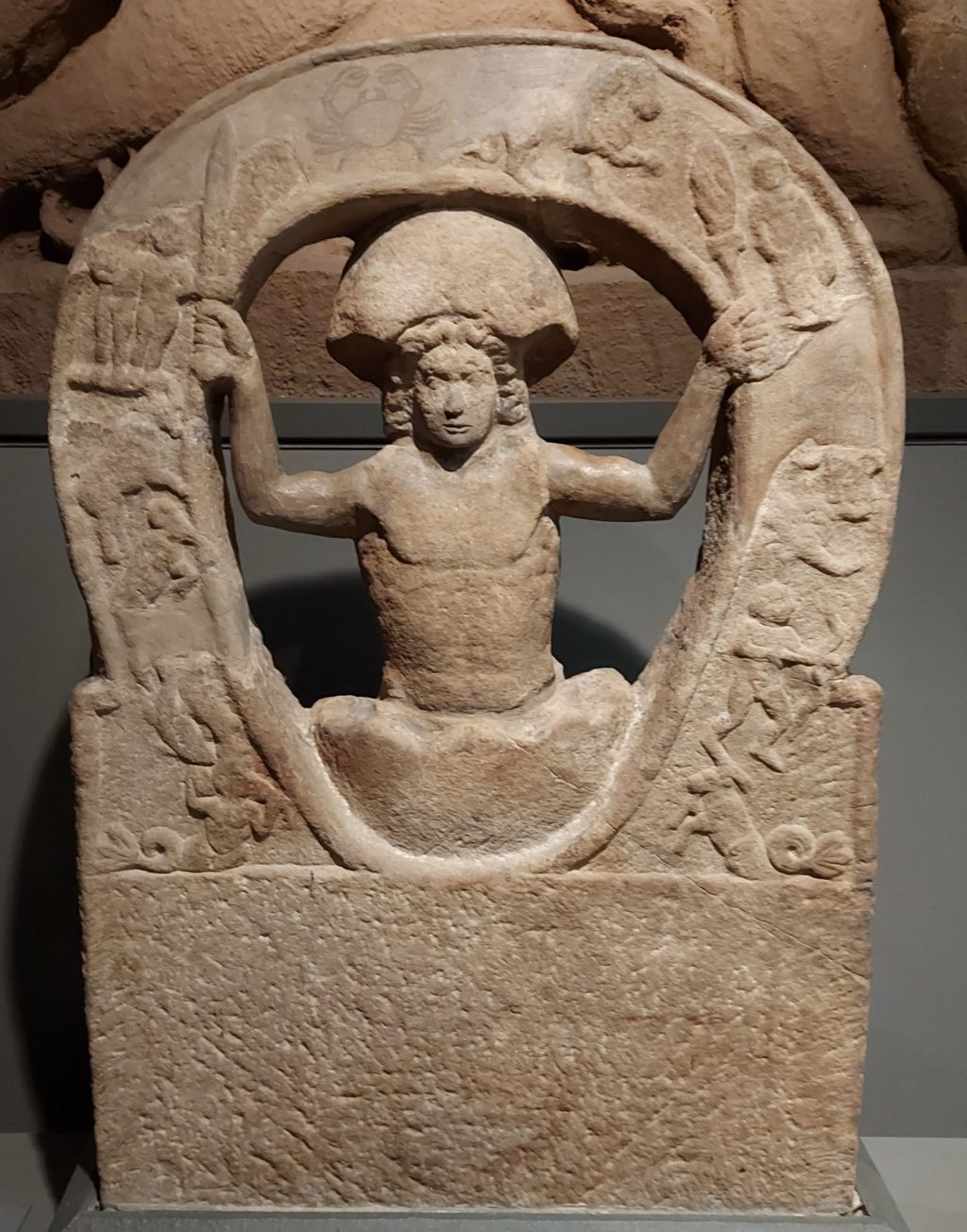
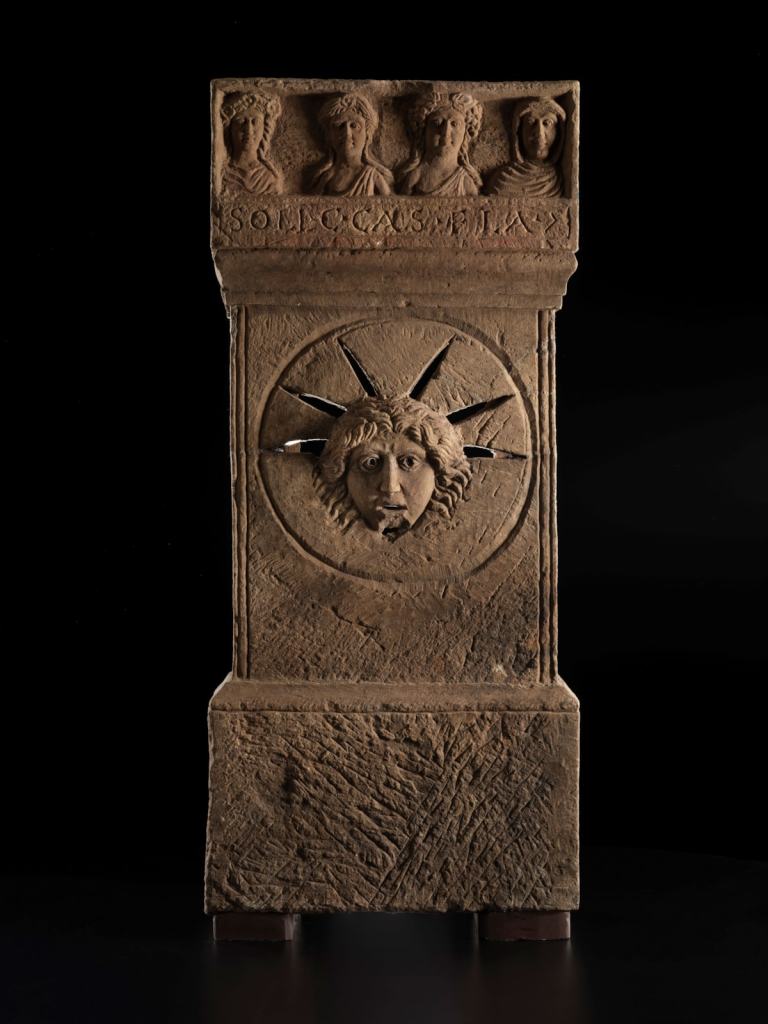
In AD 140 or thereabouts, a group of men gathered in a darkened shrine near the Roman fort at Inveresk, overlooking the Firth of Forth. Two carved stone altars stood at one end. One honoured Mithras, a mysterious god whose worshippers met in small groups; the other honoured the sun god, Sol. Light may have shone through the carved face of Sol, making his eyes and rays glow in the darkness.
This is not a scene described by a Roman eyewitness. It is a reconstruction based on an extraordinary discovery made in East Lothian in 2010. The remains of a temple and its two buried altars show that the worship of Mithras had reached Scotland by the middle of the second century AD — earlier than the securely dated Mithraic evidence elsewhere in Britain.
Who was Mithras? Why did soldiers worship him, and what happened inside his temples? Archaeology can tell us a surprising amount, although the beliefs and ceremonies of his followers remain partly hidden.
A secretive god with an eastern name
Mithras was the central figure in a Roman mystery cult that spread widely through the empire from around the end of the first century AD. A mystery cult was a religious group into which people were initiated. Its members shared rituals and knowledge not normally available to outsiders.
The name resembles that of Mithra, a much older Iranian deity associated with agreements, truth and light. Early scholars therefore assumed that the Romans had adopted an essentially Persian religion. The Belgian historian Franz Cumont made this argument influential in his great collection of Mithraic evidence, published between 1896 and 1899.
Most specialists now take a more cautious view. The Roman cult used eastern imagery, but its distinctive temples, rituals and pictures are firmly rooted in the Roman world. One important difference is the famous scene of Mithras killing a bull: it has no clear equivalent in the earlier Iranian worship of Mithra. The precise relationship between the two traditions is still debated.
The difficulty is that no complete sacred book written by Roman Mithras-worshippers survives. What we know comes mainly from temples, sculptures, inscriptions and a handful of descriptions by outsiders — some of whom were hostile to the cult.
The extraordinary Mithras temple at Inveresk
Excavations east of the Roman fort at Inveresk uncovered part of a rectangular, sunken building with benches along its sides. Archaeologists identified it as a mithraeum, or temple of Mithras. The temple belongs to the Roman occupation of southern Scotland in the AD 140s, during the reign of Antoninus Pius.
At one end lay two finely carved altars, deliberately placed face down. One was dedicated to the unconquered god Mithras by a man whose name is read as Gaius Cassius Flavianus, although parts of the name are abbreviated and uncertain. Its decoration includes symbols associated with Apollo, such as a lyre and griffin, along with ravens.
The other altar honoured Sol, the sun god. Above it were female figures representing the Four Seasons. Most strikingly, the face of Sol had pierced eyes, mouth and rays, with a hollow behind the carving into which a light could be placed. In a dim temple, the effect may have been remarkable.
The altars retain traces of colour, reminding us that Roman religious sculpture was not simply bare grey stone. Their careful burial helped preserve unusual details. The finds are held by National Museums Scotland.
Inveresk matters for two reasons. It provides the most northerly known Mithraic temple in the Roman Empire and establishes that this form of worship was present in Britain decades before the better-known temples along Hadrian’s Wall. It also gives us a rare glimpse of how darkness, painted stone and controlled light could have shaped a religious experience.
For a close look at the original altars, see our short National Museums Scotland video about the Inveresk finds. For the wider military setting, see Roman Musselburgh – Inveresk Fort.
What did a temple of Mithras look like?
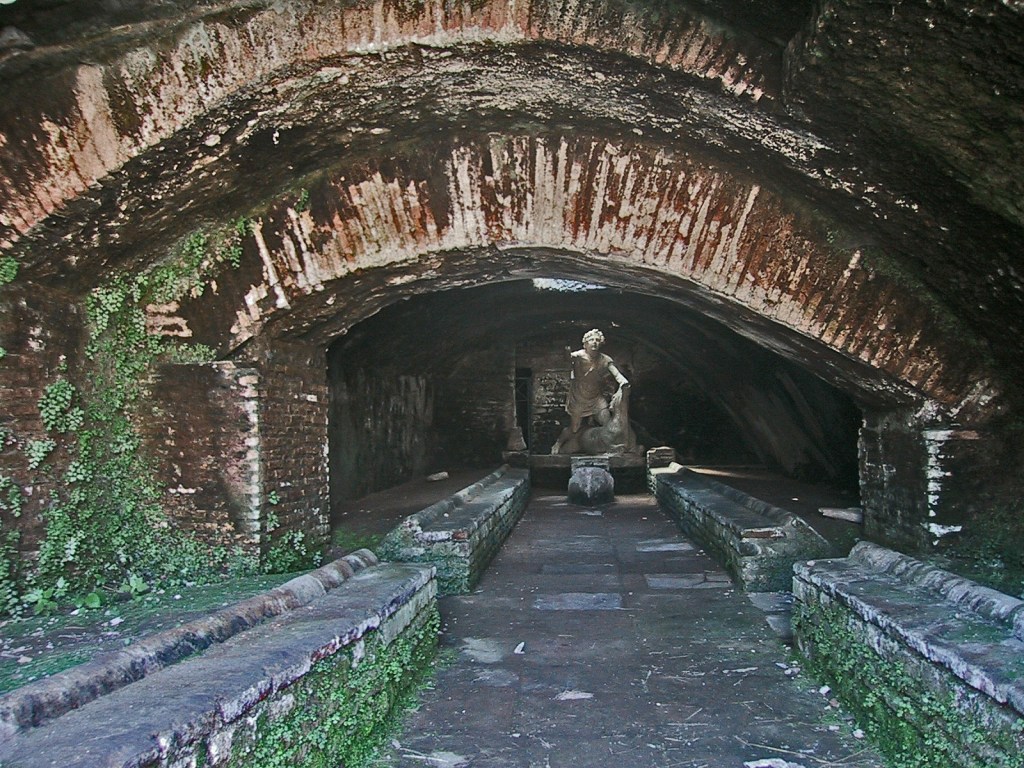
Mithraic temples were generally small, enclosed spaces. Many were underground, or built to resemble caves. A central passage ran between raised benches on which members could recline during communal meals. A relief showing Mithras killing the bull usually occupied a prominent position at the far end.
The setting was part of the experience. A visitor entering from daylight might find a low room lit by lamps, with painted images and a strong sense of separation from the outside world. That picture is partly an inference from the archaeology, but the buildings themselves leave little doubt that the atmosphere mattered.
One well-known example survives beneath the church of San Clemente in Rome. At the port of Ostia, archaeologists have found numerous Mithraic temples of varying size and design. Their differences warn us against assuming that every group followed exactly the same arrangements or ceremonies.
Why is Mithras shown killing a bull?
The most recognisable Mithraic image shows a young man in eastern-style clothing kneeling over a bull and plunging a blade into it. A dog, snake, scorpion and raven often appear nearby, while two torchbearers stand to either side. Scholars call this scene the tauroctony, meaning bull-slaying.
It was clearly central to the religion, but no surviving account by a member explains it in full. Some scholars interpret the scene as a story about life, renewal and the forces of nature. Others see a carefully arranged picture of the heavens, with animals linked to constellations.
Roger Beck has argued that the images and temple space helped worshippers imagine their place in the cosmos. David Ulansey proposed a more specific astronomical interpretation involving the slow movement of the heavens known as the precession of the equinoxes. That theory remains contested. The safest conclusion is that the picture mattered enormously, but its complete meaning is still unknown.
Who joined the cult?
The surviving evidence points strongly towards men. Women are not securely attested as ordinary members of the Roman Mithraic groups, although arguments about particular finds continue. Soldiers are prominent, especially in Britain, but the cult was not confined to the army. Traders, freedmen, enslaved people and officials also appear in the wider imperial evidence.
A small congregation could offer companionship far from home. For a soldier posted to a frontier fort, taking part in shared rituals and meals may have strengthened bonds with other members. This is a plausible explanation for the cult’s appeal, not a statement we can read directly from a worshipper’s diary.
The seven grades of initiation
Some Mithraic communities used a system of seven grades, each with its own name and associations. They were Raven (Corax), Bridegroom (Nymphus), Soldier (Miles), Lion (Leo), Persian (Perses), Sun-Runner (Heliodromus) and Father (Pater). The Father appears to have led the group.
The grades were linked to planets and religious symbols. A famous mosaic at Ostia helps show how they were represented. However, we should not assume that every worshipper in every temple worked through all seven stages. The evidence for the system is uneven, and scholars disagree about how widely it was used.
Some images suggest that initiation involved blindfolding, tests or carefully staged experiences. The precise nature of these ceremonies is uncertain. Dramatic modern descriptions of dangerous ordeals often go beyond what the archaeological evidence can prove.
Eating together in honour of Mithras
Shared meals seem to have been an important part of worship. Images show Mithras dining with Sol after the killing of the bull, and the benches inside temples would have allowed members to recline together. Animal bones, pottery and hearths found in mithraea strengthen the connection between worship and eating.
An early Christian writer, Justin Martyr, referred to bread and a cup of water used in Mithraic ceremonies. He was describing a rival religion from his own perspective, so his account needs to be treated carefully. There is no reason to assume that Mithraic meals were simply the same as Christian communion.
At Carrawburgh, near Hadrian’s Wall, excavations found evidence of hearths and the use of Mediterranean pinecones as fuel. Burning pinecones might have contributed scent and light to the ceremonies, although we cannot reconstruct an entire ritual from these finds.
Mithras at Carrawburgh on Hadrian’s Wall
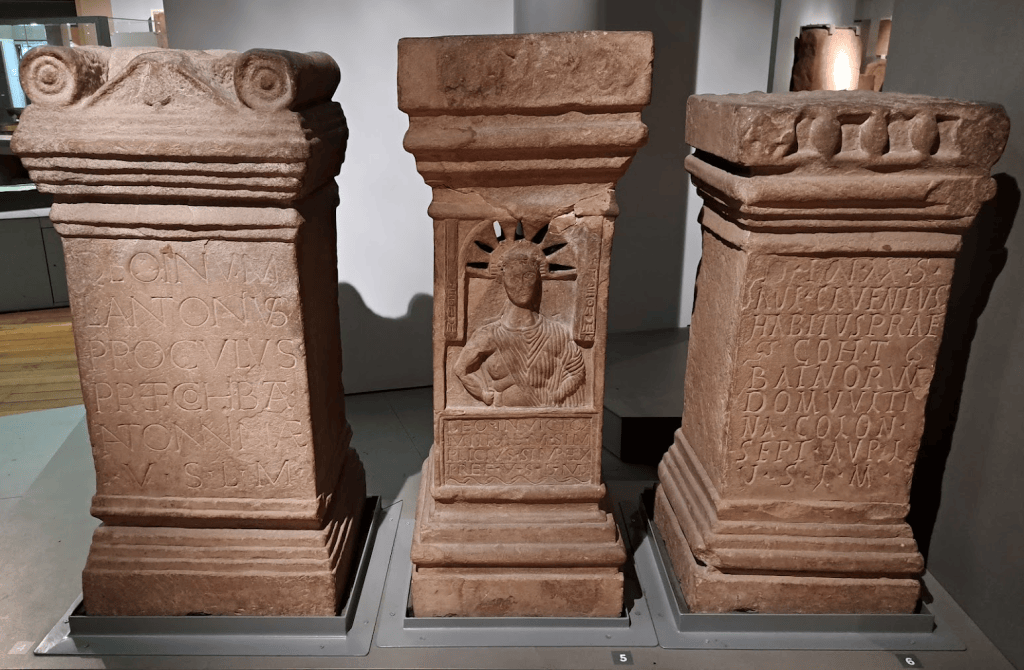
The temple at Carrawburgh, near the Roman fort of Brocolitia, was established around AD 200. Excavations revealed a sequence of building and rebuilding, showing that the shrine remained important for generations. Several commanding officers dedicated altars there.
Today visitors can see the low walls of the temple and replicas of its altars. The originals provide invaluable evidence for Mithraic worship in northern Britain. Research into surviving pigments has also shown that some religious carvings were once vividly coloured.
The site had fallen out of use by about AD 350. Some objects were damaged or removed, and waterlogging and later disturbance affected the remains. The archaeological evidence cannot always tell us who caused particular damage or why.
The colours are explored in more detail in our article Red, purple and gold: the lost colours of a Roman altar to Mithras and in the visual guide to pigments in Roman Scotland. The paint measured at Carrawburgh must not automatically be assumed to have been used at Inveresk.
Was Mithras worshipped elsewhere in the Empire?
Yes. Mithraic temples and dedications are found in Rome and Ostia, along the Rhine and Danube frontiers, and in provinces such as Dacia, in modern Romania. That distribution reflects the movement of soldiers, officials and other people around the empire.
The religion was not identical everywhere. Temples at Ostia sometimes differ markedly from the familiar two-bench plan. These variations may reflect local practice, the available buildings or changes through time rather than a single empire-wide set of rules.
What did ancient writers say?
Very little survives from the worshippers themselves, but several ancient authors help piece the story together. Statius, writing in the first century AD, refers to Mithras in a cave. Plutarch associates secret rites of Mithras with pirates from Cilicia, although this does not prove where the Roman cult began.
The philosopher Porphyry later described the Mithraic cave as a model of the universe. Christian authors including Justin Martyr and Tertullian discussed some ceremonies, usually to criticise them. These texts are useful clues, but they do not provide an impartial handbook to the religion.
Older Greek accounts of the Persian Mithra must be kept separate from evidence for the Roman mysteries. Similar names do not by themselves prove identical beliefs or rituals.
Why did the cult disappear?
Mithraic worship declined during late antiquity, as Roman religious life changed and Christianity gained official support. Temples were abandoned, altered or sometimes deliberately damaged. There was no single event that ended the cult across the empire.
David Walsh’s work on later Mithraic temples points to a more complicated picture than a straightforward contest between two religions. Some congregations may have changed their practices, while others disappeared as their local supporters moved away or died. Because temples were small communities, the loss of a few key members could matter greatly.
How has our understanding changed?
For many years, Franz Cumont’s explanation of Mithraism as a Persian religion transplanted to Rome dominated research. At a major scholarly meeting in Manchester in 1971, that picture came under sustained criticism. Researchers such as John Hinnells and Richard Gordon asked whether the supposed links to Persian religion were actually supported by the evidence.
Manfred Clauss placed greater emphasis on the Roman setting, the social lives of worshippers and the archaeological record. Roger Beck and others have explored the possible astronomical meanings of Mithraic images. More recent work looks closely at how temples were built, used, lit, decorated and eventually abandoned.
These approaches do not all agree. That is part of what makes Mithras worth studying: there is substantial physical evidence, but no surviving explanation that settles every question.
What Mithras tells us about Roman Scotland
The Inveresk discovery changes the story of Mithras in Britain. The cult was already present at the northern edge of the Roman world in the AD 140s. The soldiers and other people who worshipped there took part in a religion shared with communities hundreds of miles away, yet their temple had its own remarkable features.
The glowing face of Sol, the carved Four Seasons and the buried altars allow us to imagine something of the setting without pretending that we know exactly what the worshippers believed. Together with Carrawburgh, they remind us that Rome’s northern frontier was not only a landscape of forts, roads and military campaigns. It was also a place where people gathered, ate together and tried to make sense of the universe.
Explore Mithras elsewhere on this site
- Mithras — short introduction, lecture and European sites map
- The Inveresk Mithras altars — National Museums Scotland video
- Carrawburgh altar colours — detailed scientific evidence
- Roman Scotland pigments — what the colour tests really found
- Gods & Beliefs in Roman Scotland
Sources and further reading
The following sources preserve the main archaeological evidence and the principal lines of scholarly debate covered in the longer research article. The original published survey remains available with its extensive bibliography.
- Hunter, Henig, Sauer and Gooder, “Mithras in Scotland: A Mithraeum at Inveresk (East Lothian)”, Britannia (2016)
- Roman Inscriptions of Britain: the Mithras altar at Inveresk
- National Museums Scotland: Inveresk altars and their imagery
- English Heritage: History of the Temple of Mithras at Carrawburgh
- Scientific analysis and reconstruction of colour on a Carrawburgh altar
- Encyclopaedia Iranica: Mithraism — an overview of debates about origins and grades
- Franz Cumont, Textes et monuments figurés relatifs aux mystères de Mithra (1896–1899)
- Manfred Clauss, The Roman Cult of Mithras: The God and His Mysteries (2000); academic review
- Roger Beck, The Religion of the Mithras Cult in the Roman Empire (2006); publisher information
- David Walsh, “The transformation of Mithraea in the Late Roman period”
- Ancient literary references to Mithras
- The New Mithraeum — catalogue of sites, monuments and research
- Original full research survey and bibliography

