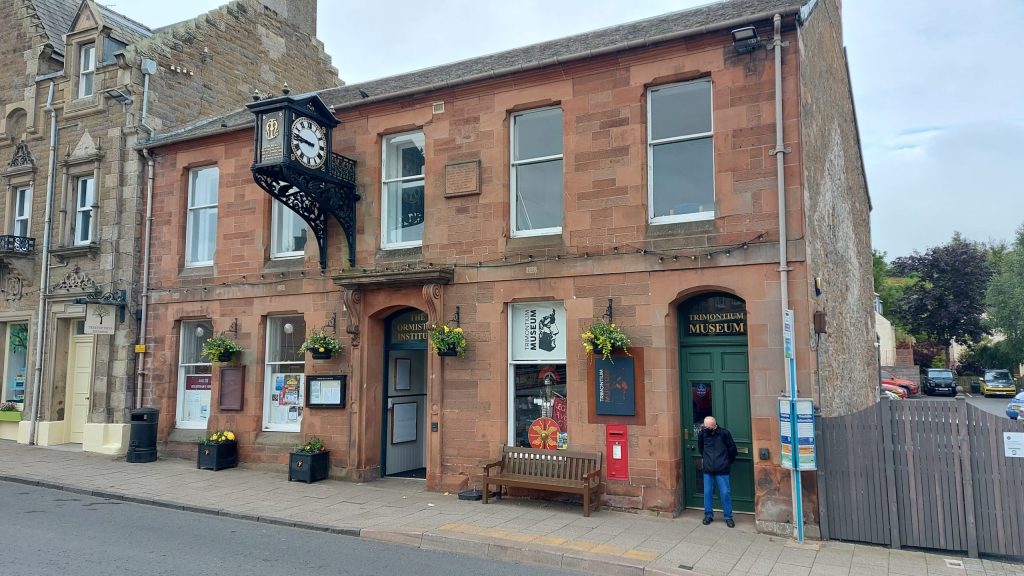
Trimontium Museum is the best starting point for exploring the Roman story of Melrose and the Scottish Borders. Its displays bring together the remarkable archaeology of the great fort complex at Newstead, where Roman soldiers, local communities, traders and families lived at different periods between the late first and second centuries AD.
The museum is compact, but its focus is unusually strong: it explains both the Roman invasions of Scotland and the experiences of the people who encountered the army. It is particularly valuable because it can be combined with a walk to the fort and amphitheatre site east of Melrose.
Plan your visit
Location: Market Square, Melrose, Scottish Borders, TD6 9PN
Roman focus: Trimontium Roman fort, the Roman army and the peoples of the Scottish Borders
Admission and opening: Check current arrangements before travelling
Official website: Visit the Trimontium Museum website
Map: Open in Google Maps
What can you see?
The galleries use original objects, replicas, film and interactive interpretation to reconstruct life at Trimontium. The collection ranges from military equipment and tools to personal belongings that reveal the people behind the archaeology.
More than 200 objects from the Scottish Borders are on loan from National Museums Scotland. Together they show that a Roman fort was not simply a defensive enclosure: it was a busy community supplied by craftspeople, farmers and traders and connected to routes running across southern Scotland.
Highlights include:
- Roman weapons, armour and military equipment associated with the garrison;
- leather shoes belonging to adults and children, preserved in waterlogged wells;
- tools, cooking vessels, lamps and quernstones illustrating work and daily life;
- intaglios, brooches and other personal objects;
- evidence for the Iron Age communities who lived in the Borders before and during the Roman occupations.
The museum also offers virtual-reality and object-handling experiences, although these may require separate booking. Displays and available activities can change, so consult the official website when planning your visit.
Why does Trimontium matter?
Trimontium was one of the largest and most important Roman military complexes north of Hadrian’s Wall. Its position beside Dere Street and close to the River Tweed allowed it to control movement through the Borders and to support campaigns farther north. The site was occupied and rebuilt more than once as Rome’s ambitions in Scotland changed.
Excavations revealed forts, annexes, temporary camps and an amphitheatre. The finds recovered from pits and wells form one of the richest bodies of evidence for the Roman army in Scotland. The museum gives those objects their landscape and human context, linking military history with the lives of soldiers, civilians and local Iron Age communities.
Combine your visit with
- Trimontium Roman Fort at Newstead — the fort site and amphitheatre lie about 1½ miles east of Melrose.
- The Romans around Melrose — a local introduction to the wider Roman landscape.
- Roman forts in Scotland — discover how Trimontium fits into the wider military network.
- Museums map — find other collections containing evidence from Roman Scotland.
Before travelling: Displays, opening arrangements, experiences and admission charges can change. Check the museum’s official website for current information.

