Read the evidence for yourself
How do we know what happened when the Romans came to Scotland?
Roman historians described campaigns in northern Britain. Geographers recorded the names of peoples and places. Soldiers carved their names into altars and tombstones. Legions erected monumental inscriptions recording their construction of the Antonine Wall.
These are primary sources — evidence created in, or close to, the Roman period itself.
Here you can explore some of the most important sources for Roman Scotland.
📜 Tacitus — Agricola
Our most important account of the Roman invasion of Scotland
The Roman historian Tacitus wrote the Agricola around AD 98. It is a biography of his father-in-law, Gnaeus Julius Agricola, governor of Britain and commander of the campaigns which took the Roman army deep into what is now Scotland.
Tacitus describes Agricola’s northern campaigns, fighting with the Caledonians, the Roman fleet sailing around northern Britain and the famous Battle of Mons Graupius.
He also gives us the speech supposedly delivered by the Caledonian leader Calgacus, including one of the most famous condemnations of Roman imperialism:
“They make a desert and call it peace.”
But did Calgacus really say it? Almost certainly not in the form Tacitus gives us. Ancient historians routinely composed speeches for historical figures. That makes the Agricola invaluable evidence — but not an eyewitness transcript.
Best for: Agricola • Calgacus • Mons Graupius • Caledonians • Flavian campaigns • Roman fleet
Read Tacitus’ Agricola in English — Perseus Digital Library
See the original Latin and other editions — Perseus
Perseus provides both the Latin text and an English translation of the Agricola.
⚔️ Cassius Dio — Roman History
Septimius Severus goes to war in Scotland
For events more than a century after Agricola, one of our most important sources is Cassius Dio.
Dio was a Roman senator, historian and politician who lived during the reign of Septimius Severus.
His Roman History provides crucial evidence for northern Britain in the early third century, including the Caledonians and Maeatae and Severus’ great expedition into Scotland in AD 208–211.
Dio describes an extremely difficult campaign in which Roman troops struggled with forests, marshes and unfamiliar terrain. He claims enormous Roman losses.
We need to be cautious with his figures, but his account is fundamental to understanding Rome’s final major attempt to conquer Scotland.
Best for: Septimius Severus • Caledonians • Maeatae • AD 208–211 • Roman campaigning
Read Cassius Dio’s Roman History — LacusCurtius
For Scotland, Books 76 and 77 are particularly important: the surviving text covers warfare in Caledonia and Severus’ personal campaign before his death at York.
🗺️ Ptolemy — Geography
Putting Roman Scotland on the map
The second-century scholar Claudius Ptolemy attempted something extraordinary: to describe the known world using coordinates.
His Geography preserves names for peoples and places in northern Britain which would otherwise have been lost.
Among the peoples he records are the:
Caledonii • Vacomagi • Taexali • Venicones • Damnonii
He also records settlements, promontories, rivers and islands.
There is a complication.
Ptolemy’s northern Britain is famously distorted. Scotland effectively bends eastwards, and identifying some of his ancient names with modern places remains controversial.
Nevertheless, his work is one of our most important sources for the geography and peoples of Roman-period Scotland.
Best for: tribes • ancient place names • geography • settlements • mapping Scotland
Explore Ptolemy’s Geography — LacusCurtius
🛡️ Herodian — History of the Roman Empire
Another account of Severus in Britain
Cassius Dio isn’t our only source for the campaigns of Septimius Severus.
Herodian, writing in the third century, also describes Severus travelling to Britain and campaigning in the north.
His account contains vivid descriptions of the landscape and the peoples encountered by the Romans.
As with Dio, however, we shouldn’t assume every colourful detail is literally true.
The great advantage is that we can compare Herodian with Cassius Dio and the archaeological evidence.
Where independent sources agree, our confidence increases. Where they disagree, things become more interesting.
Best for: Septimius Severus • northern peoples • Roman campaigning • comparing ancient accounts
Read Herodian’s Roman History — Livius
🏺 Ammianus Marcellinus
Scotland and Rome in the fourth century
Roman involvement with northern Britain did not end with Septimius Severus.
By the fourth century, Roman writers increasingly refer to peoples called Picts, alongside the Scots, Attacotti and Saxons.
The historian Ammianus Marcellinus is particularly important for the crisis of AD 367, sometimes called the Barbarian Conspiracy, and the subsequent campaign of the Roman general Theodosius.
His account takes us into a very different world from Agricola’s invasion almost three centuries earlier.
Best for: Picts • fourth-century Scotland • Barbarian Conspiracy • Theodosius • late Roman Britain
Read Ammianus Marcellinus — LacusCurtius
🪨 Roman Inscriptions of Britain
Let the people who were here speak
Ancient historians usually wrote about emperors, generals and wars.
Inscriptions give us something different. They preserve the names of ordinary soldiers, centurions, commanders, families and worshippers who actually lived in Roman Scotland.
An altar might tell us:
who dedicated it • which god they worshipped • their military unit • their rank • sometimes where they came from
A tombstone might preserve:
a person’s name • age • birthplace • years of military service • family relationships
And a building inscription might identify the soldiers who built a fort or section of frontier.
The essential resource is Roman Inscriptions of Britain — RIB Online. It now contains the major monumental inscription collections as well as newer inscriptions published through the annual Britannia reports, and its search covers inscription texts, translations and metadata.
Search Roman Inscriptions of Britain
Explore Scotland directly
RIB allows you to browse inscriptions specifically by Scottish findspot rather than searching the whole database.
Try searching for places such as:
Cramond • Inveresk • Newstead • Mumrills • Auchendavy • Castlecary • Bar Hill • Birrens
🧱 The Antonine Wall Distance Slabs
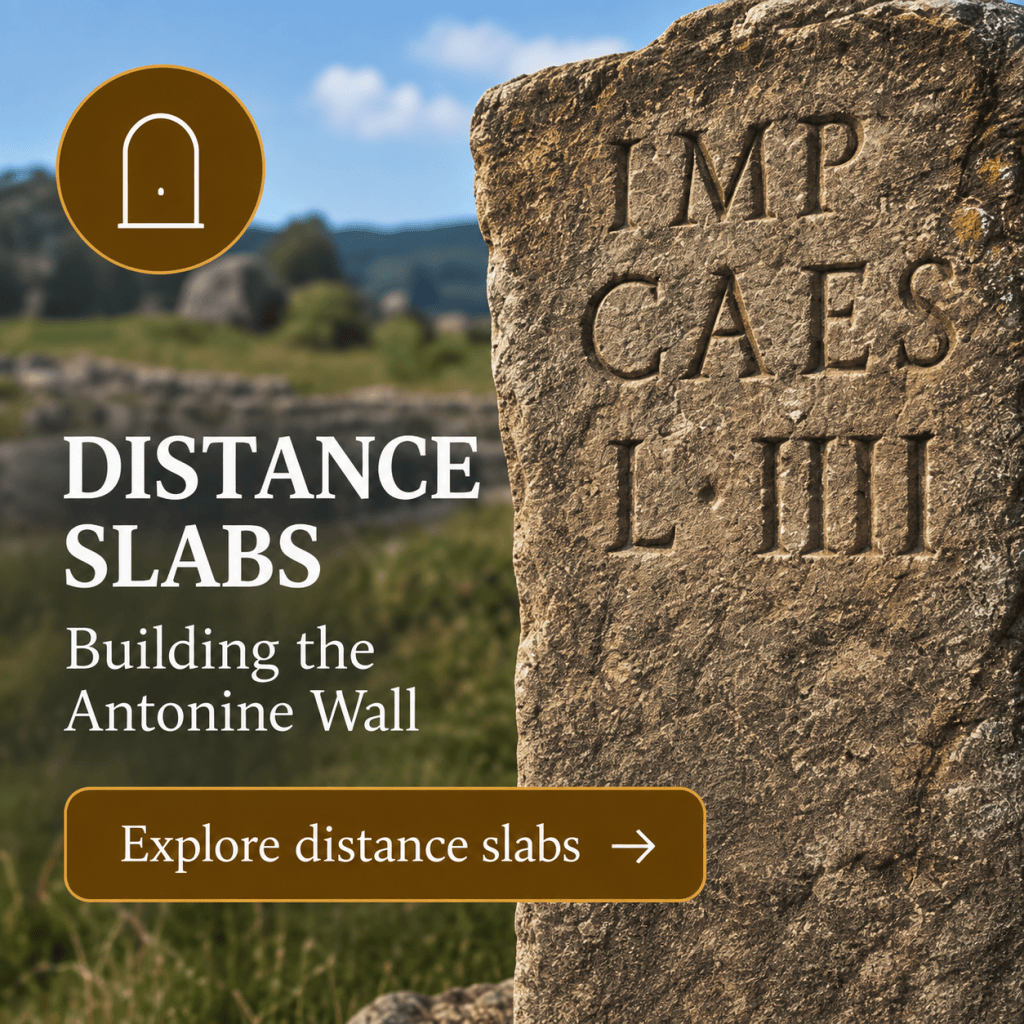
The distance slabs are among the most extraordinary primary sources surviving from Roman Britain.
Eighteen are known.
They record sections of the Antonine Wall constructed by the three legions involved:
Legio II Augusta
Legio VI Victrix
Legio XX Valeria Victrix
But they are much more than construction records.
Their elaborate sculpture depicts Victory, legionary emblems, Roman soldiers and defeated enemies. They were statements of Roman military achievement and imperial power.
Because they also record distances, archaeologists can use them to investigate how construction of the Antonine Wall was divided between the legions.
Best for: Antonine Wall • legions • construction • inscriptions • Roman propaganda
→ All 18 Antonine Wall Distance Slabs
🏛️ Altars
Roman altars can be surprisingly personal.
A dedication might have been made because somebody survived an illness, completed a journey, received a promotion or simply wanted to fulfil a promise to a god. Scotland’s Roman altars introduce us to gods worshipped by people who had travelled here from across the Empire.
They include:
Jupiter • Mars • Minerva • Victory • Diana • Apollo • Hercules • Epona • Mithras
At Auchendavy, the centurion Marcus Cocceius Firmus left an extraordinary series of dedications.
At Inveresk, remarkable altars provide evidence for the worship of Mithras.
These aren’t merely religious objects. They provide evidence for people, military units, migration and cultural identity.
Internal links:
→ Roman Altars in Scotland
→ Marcus Cocceius Firmus
→ Gods & Religion
→ Mithras at Inveresk
🪦 Tombstones
A Roman tombstone can turn an archaeological site into the story of an individual. At Mumrills we meet Nectovelius, son of Vindex, a Brigantian who died aged only 29 after serving with the Second Cohort of Thracians.
Elsewhere, inscriptions reveal soldiers and officers who had travelled hundreds or thousands of miles before eventually finding themselves in Scotland. Tombstones therefore help answer one of the most interesting questions about Roman Scotland:
Who were the Romans?
The answer is much more complicated than simply “people from Rome”.
Internal links:
→ People of Roman Scotland
→ Women in Roman Scotland
🪙 Coins
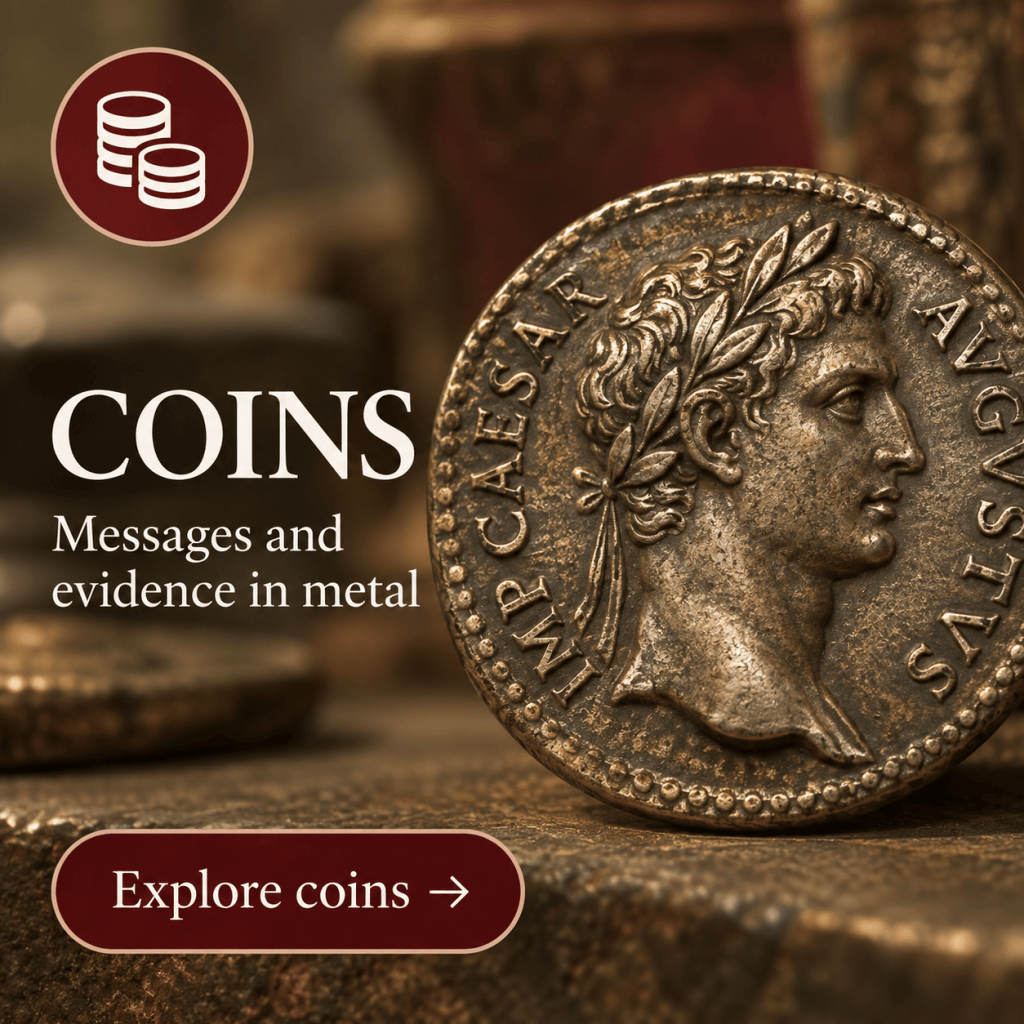
Coins are documents too. Their portraits, inscriptions and imagery carried carefully chosen messages about the emperor and the Roman state.
Coins can also help archaeologists understand the chronology of Roman sites.
But there is an important warning:
The date a coin was minted is not necessarily the date it was lost.
A coin could remain in circulation for decades. That means coins need to be interpreted alongside the archaeological context in which they were discovered.
Internal links:
→ Roman Coins Found in Scotland
→ Roman Coin Map
📚 Later Roman writers
Other ancient authors become important when we investigate the final centuries of Roman involvement with northern Britain.
These include Orosius, Claudian and other late Roman writers.
They are particularly valuable for the emergence of the Picts and the increasingly unstable northern frontier during the fourth and early fifth centuries.
Perseus Digital Library — Greek and Roman texts
→ Free Books and Ancient Sources
⚠️ Primary doesn’t mean true
There is one important rule when using all these sources:
A primary source is original evidence. It isn’t necessarily accurate evidence.
Tacitus wanted his father-in-law Agricola to appear impressive. Cassius Dio wrote from a Roman elite perspective. Ancient historians invented speeches. Ptolemy made geographical errors. An emperor’s inscription promoted imperial authority.
A distance slab celebrated the achievement of a Roman legion. An altar tells us what one person chose to dedicate, not what everybody in Roman Scotland believed.
So the best way to reconstruct Roman Scotland is to bring different evidence together:
📜 Ancient texts + 🪨 inscriptions + 🏺 artefacts + ⛏️ archaeology + 🗺️ landscape
When they agree, we can be more confident. When they disagree, the history often becomes much more interesting.