Sma’ Glen Roman watchtower stood above one of the natural approaches through the Perthshire hills. Near the southern entrance to the glen, the Romans also established Fendoch Fort. Together the two sites illustrate how a fort and an outlying lookout could watch a difficult route into the Highlands.
Visit Sma’ Glen
📍 Location: Above the western side of the southern entrance to the Sma’ Glen, Perth and Kinross.
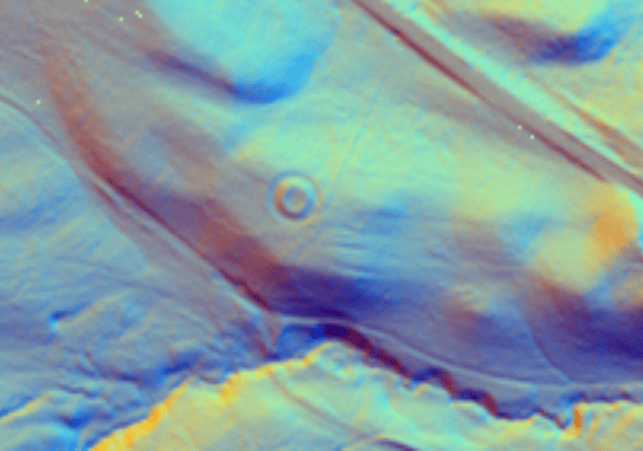
👁 What survives: A near-circular bank, ditch and sunken platform; no timber tower stands.
⭐ Best for: Understanding a Roman lookout overlooking a natural route through the Highland hills, away from the main Gask Ridge road.
🥾 Visit: The earthwork occupies elevated ground, not a developed visitor attraction. The map pin is a general locator, not a parking place or confirmed access route. Follow local access guidance and take care on uneven ground.
🏛 Explore nearby: Fendoch Roman Fort · Gask Ridge watchtower guide
Approximate location marker for orientation only. It is not a surveyed boundary or an established visitor access point.
Sma’ Glen at a glance
| Feature | Evidence and interpretation |
|---|---|
| Date | Usually considered in the context of the late first-century Roman military occupation; exact dating of this installation remains uncertain. |
| Enclosure | Near-circular bank about 22 m across, measured centre to centre; ditch surrounds a slightly hollowed interior approximately 16 m across. |
| Timber tower | Likely wooden superstructure, but its actual footprint, height and upper floors are not securely known from this site. |
| Landscape position | Elevated above the entrance to Sma’ Glen, rather than alongside the main Gask Ridge road. |
| Possible communication | Fendoch is a plausible focus for observation and messages; a particular signal route or system has not been demonstrated. |
| Garrison | Unit and number of soldiers unknown. |
The remains and their investigation
The surviving earthwork is broadly circular. Survey records describe an enclosing bank of about 22 metres across, measured between bank centres, with a ditch around an interior platform roughly 16 metres across. These are dimensions of the enclosure, not the timber tower itself.
An old field boundary cuts across the south-eastern section. Earlier aerial photography and Ordnance Survey field visits, including those in 1968 and 1975, record the installation. The bank, ditch and platform help identify the site, but do not provide a secure reconstruction of the tower’s height, doors, roof or upper storeys.
Watching the Highland route
The Sma’ Glen follows the River Almond through a natural break in the surrounding hills. Observation from this position could have helped Roman soldiers monitor movement towards the Highlands. The station’s placement also makes sense in relation to nearby Fendoch, at the southern approach to the glen.
The wider military purpose is plausible, but the archaeological remains do not reveal who travelled through the glen, how often the lookout was occupied or how its duties were organised. Explore Fendoch Roman Fort.
Sma’ Glen and the Gask Ridge
The station is not one of the closely spaced roadside towers on the main Gask Ridge line. It is better understood as an outlying observation point associated with the wider Roman military landscape of Perthshire. See the Roman Gask Ridge watchtower guide for the main sequence of sites.
Possible communication with Fendoch
Its commanding position raises the possibility that the lookout exchanged visible signals with Fendoch. Signals involving smoke or fire are conceivable, but no specific Roman code, route, timing or even direct line of sight has been demonstrated here. The hypothesis should not be confused with excavation evidence.
How securely is it dated?
Sma’ Glen is normally discussed alongside Roman military installations of the Flavian period in the late first century AD. This is contextual attribution, not a securely dated foundation or abandonment event recovered from this particular earthwork.
References and further reading
Trove: Sma’ Glen, place 26121 — archaeological location, survey history and earthwork descriptions.
Romans in Scotland: Fendoch Roman Fort — background on the nearby military position.
Romans in Scotland: Roman Gask Ridge Watchtowers — the main watchtower sequence and wider frontier context.

