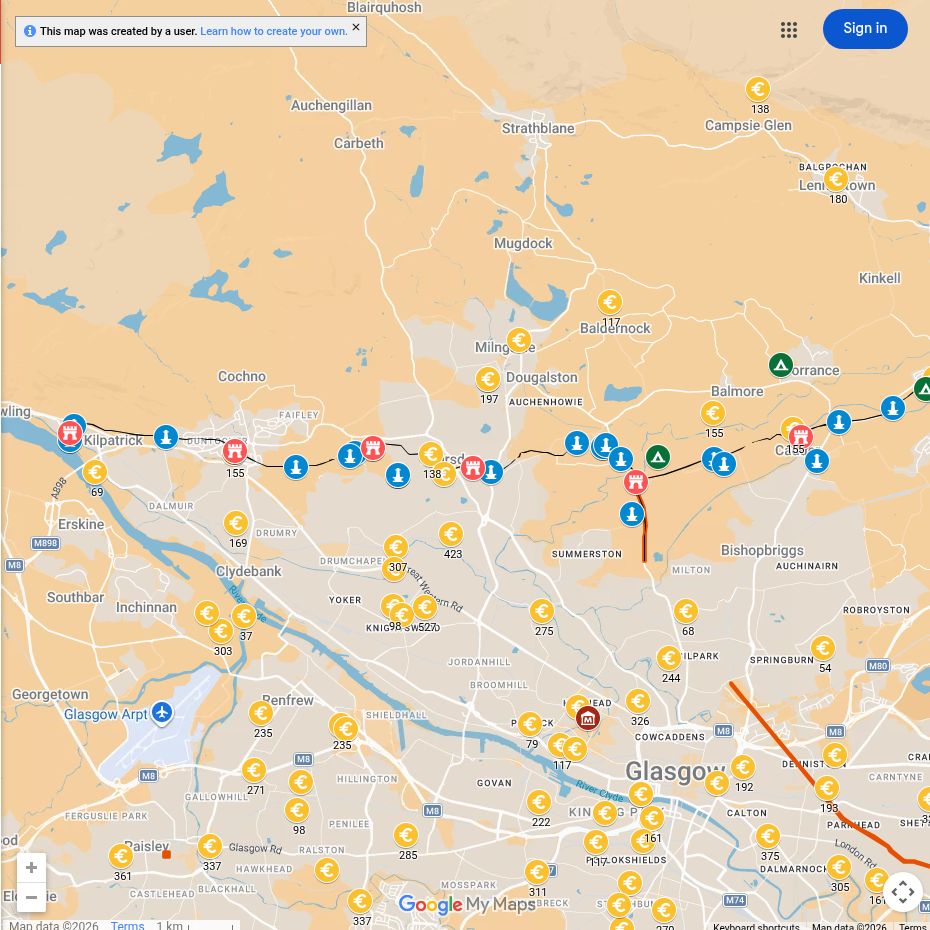
Roman Bearsden is unusually close to the surface of the modern town. The Antonine Wall crosses gardens, roads and open spaces, while the remains of a Roman bathhouse survive only a short distance from the town centre.
Amazing fact
Bearsden’s Roman latrine preserved traces of figs, coriander, cereals and intestinal parasites—an extraordinarily personal picture of the soldiers’ diet and health.
The archaeology does more than show where soldiers lived. Waterlogged deposits from the fort’s drainage and latrine systems preserve evidence of their food, health and daily routines. Bearsden therefore provides one of the most intimate pictures of life anywhere on Rome’s northern frontier.
A fort on the Antonine Wall
The fort was constructed around AD 142 as part of the Antonine frontier. Its irregular outline was adapted to the available ground, but excavation showed that its buildings were carefully planned using a measured grid.
The defences consisted of a turf rampart on a stone base and several ditches. Inside stood the headquarters building, a granary and barracks. An annexe beside the fort contained the bathhouse, latrine and service areas.
An inscription records building work by the Twentieth Legion, but the fort’s garrison was probably an auxiliary unit rather than legionaries. The Fourth Cohort of Gauls, a mixed infantry and cavalry regiment, is commonly associated with Bearsden. As elsewhere on the Wall, legionaries helped construct the frontier while auxiliary soldiers normally provided its garrisons.
Read the detailed guide to Bearsden Roman Fort
Inside the fort
The soldiers lived in barrack blocks divided into small rooms. Each group of rooms accommodated a contubernium — the smallest living unit in the Roman army. The headquarters building formed the administrative and religious centre of the fort, while the granary protected essential food supplies from damp and pests.
Excavation revealed more than one phase of construction. Buildings were altered and the bathhouse was reorganised during the fort’s relatively short life. These changes are a reminder that forts were working places, continually repaired and adapted rather than completed once and left unchanged.
The bathhouse and latrine
The visible bathhouse is the best-known Roman monument in Bearsden. Soldiers moved through rooms of different temperatures, using heat generated in a furnace and circulated beneath raised floors.
Beside the baths was a communal latrine. A water channel carried waste away, creating deposits that later gave archaeologists exceptional evidence about the fort’s occupants.
Analysis identified traces of wheat, barley, beans, lentils, figs, coriander, dill, celery, berries and nuts. Some foods were locally available; others reached Bearsden through Roman trading and supply networks. Parasite eggs also survived, showing that sophisticated drainage and bathing facilities did not protect soldiers from intestinal infection.
Discover food and drink in Roman Scotland
People beyond the ramparts
Roman forts did not necessarily stand alone. Cobbled surfaces and domestic material found west of Bearsden fort have been interpreted as evidence for activity outside the defences, possibly part of a small civilian settlement or vicus.
Such communities might include soldiers’ families, traders, craftspeople and other people serving the military population. The evidence at Bearsden is incomplete, so it should not be imagined as a large town. It does, however, remind us that the frontier was inhabited by many people besides uniformed soldiers.
A newly recognised fortlet
Investigations in gardens beside Boclair Road revealed stonework and a ditch interpreted as a previously unknown Roman fortlet. Its position, south of the Wall and within sight of the larger fort, suggests that it helped monitor movement through the local frontier landscape.
The discovery demonstrates that important evidence can survive beneath ordinary suburban gardens. It also complicates the older picture of forts and fortlets positioned at simple, regular intervals.
Read about the Boclair Road fortlet
The end of Roman Bearsden
Coins and pottery suggest that the fort was occupied for only around fifteen to twenty years. When the garrison withdrew, parts of the fort appear to have been deliberately demolished or burned.
Rome did not disappear from Britain, but the army abandoned the Antonine Wall and concentrated once again on Hadrian’s Wall. The turf ramparts decayed, stone was reused and the site gradually became part of the later landscape.
What can you see today?
- Bearsden Roman bathhouse: the principal visible Roman remains in the town.
- The Antonine Wall line: followed through several parts of Bearsden, although survival varies greatly.
- New Kilpatrick Cemetery area: close to the fort and bathhouse complex.
- Boclair Road: the fortlet lies on private residential ground and is not a visitor attraction.
The bathhouse is the natural starting point. A walk through Bearsden then helps reveal how closely the modern town overlies the Roman frontier.

