At Inveresk, above the River Esk, archaeologists have uncovered a Roman fort, a civilian settlement, bathing facilities, religious altars and burials. These four stories give a glimpse of the people who lived here nearly 1,900 years ago.
Four stories from Roman Musselburgh
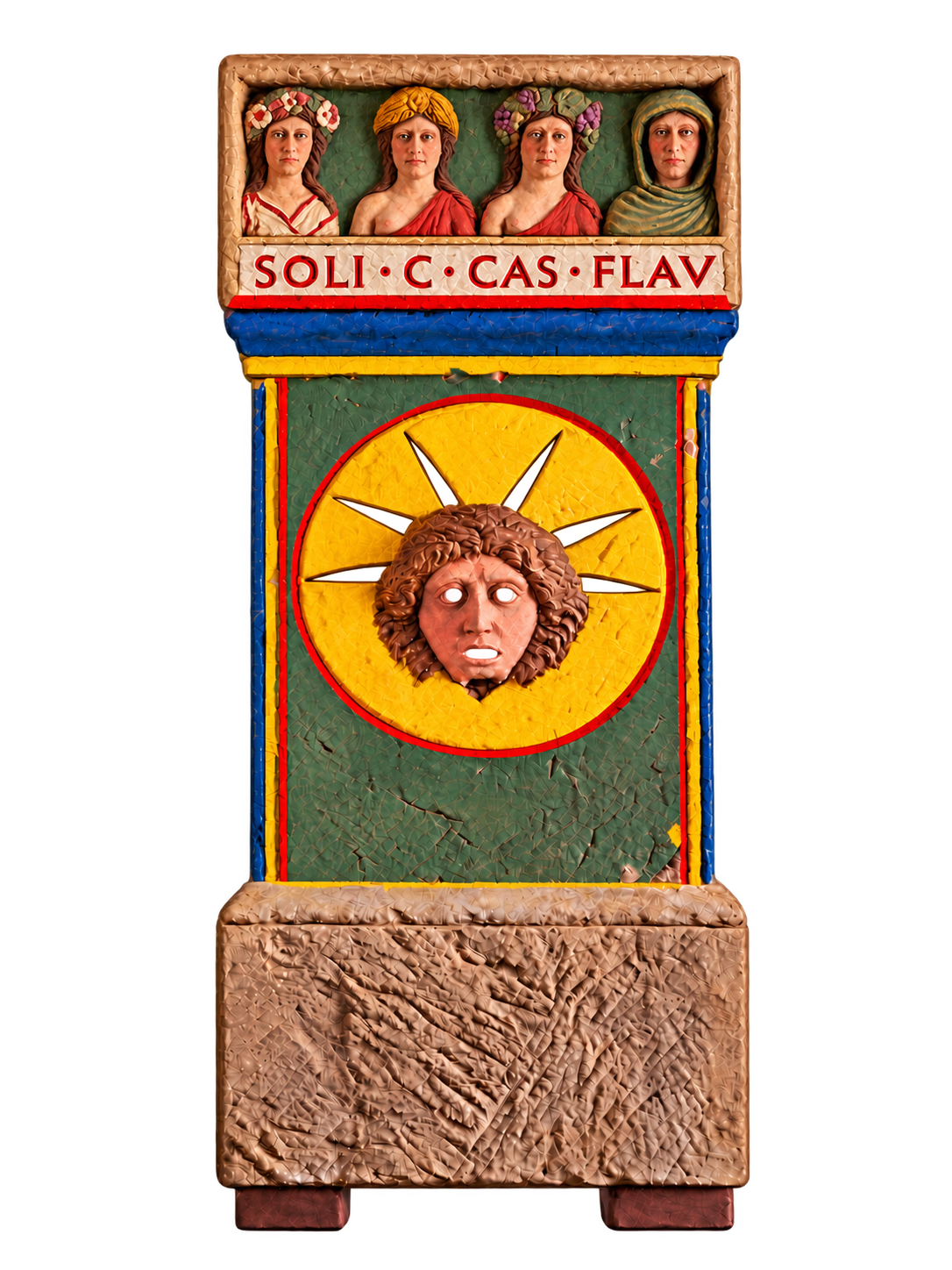
The colourful Roman gods
Explore the altars to Sol and Mithras and the evidence for their ancient colours.
Modern colour reconstruction; the original colour scheme is not fully known.
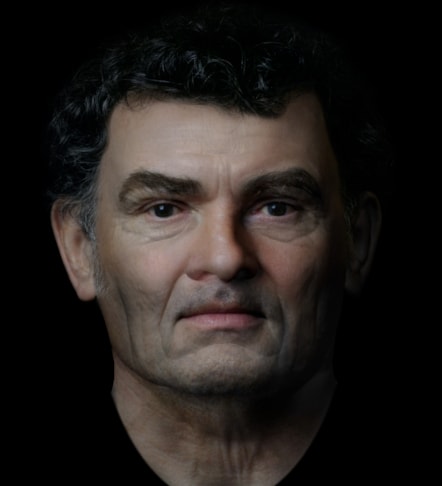
The man from Inveresk
See the face reconstructed from a Roman-period burial and discover what his bones reveal.
Facial reconstruction © Chris Rynn. Used on the existing feature article.
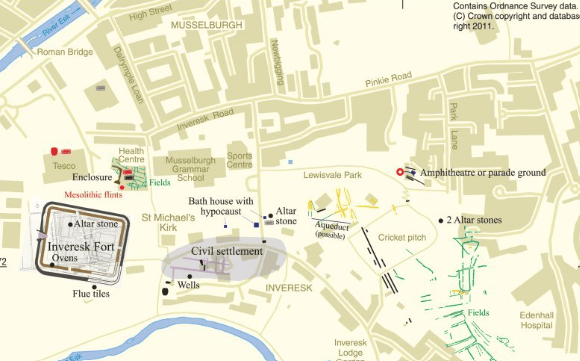
The fort and its civilian settlement
Find out about the Roman buildings and people whose traces survive beneath Inveresk.
Archaeological site map © Historic Environment Scotland; educational use only.
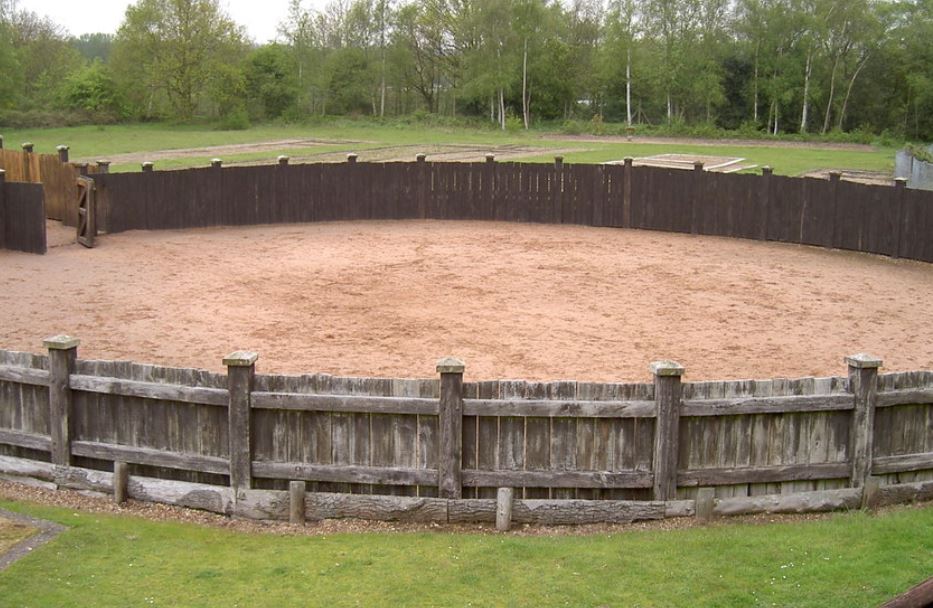
Was there an amphitheatre?
Explore a possible timber structure, and why its interpretation is still debated.
Comparative illustration of Lunt, not Inveresk. © Neil Owen.
Explore Roman Musselburgh
Open the interactive map below to explore the wider area. Archaeological locations are not all equally certain: the guide beneath the map separates excavated remains from possible or proposed identifications. The map is a guide, not a survey-accurate reconstruction of the Roman landscape.
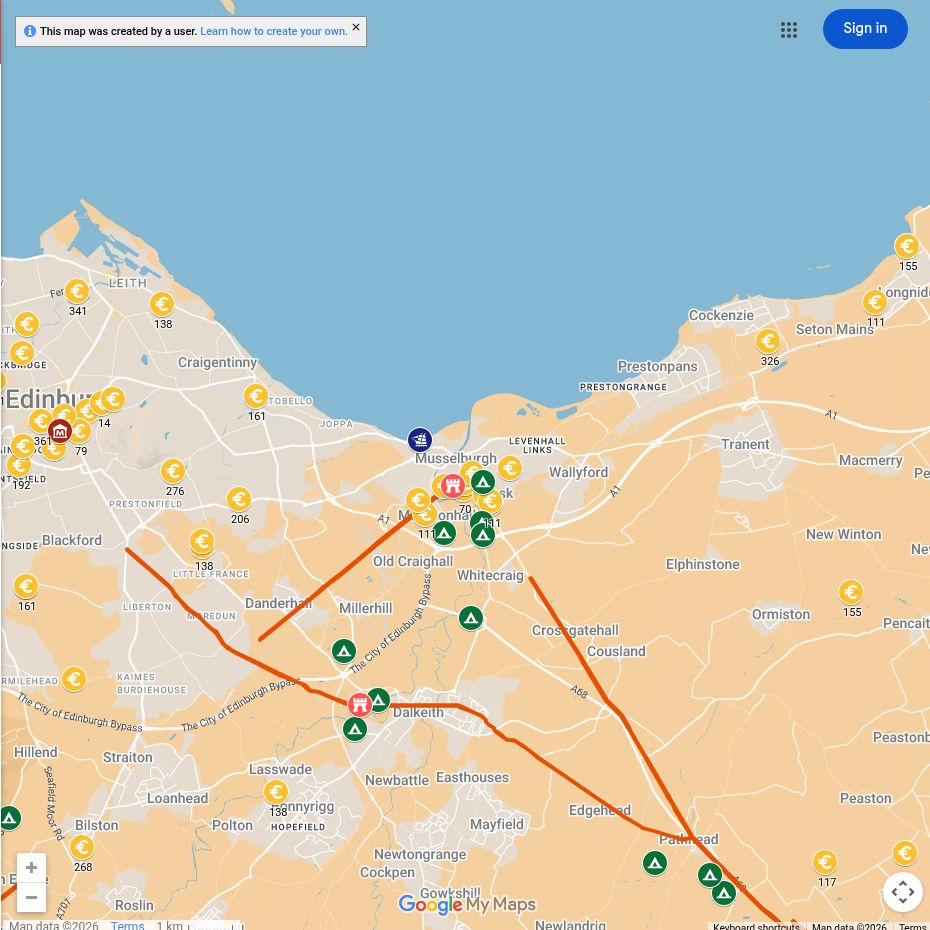
Places on the map: what is known?
- Inveresk Roman fort — excavated. The fort lay on the ridge around St Michael’s Church and churchyard. Excavation has revealed military defences and phases of Roman activity.
- Civilian settlement — excavated. Roman buildings and finds have been recorded outside the fort, including near Inveresk House, Inveresk Brae and Eskgrove. Its full layout is not known.
- Bathhouse — excavated. Remains around Inveresk House include evidence of heating and bathing facilities. These are archaeological remains, not a surviving public bath building.
- Mithraeum and altars — excavated, with interpretation. Two altars to Mithras and Sol were found in 2010 east of the fort, associated with a sunken structure interpreted as a Mithraeum. Their exact original appearance is partly uncertain.
- Roman burials north of the fort — excavated. Six Roman-period inhumations, including four decapitated burials, were excavated at the Musselburgh Primary Health Care Centre site.
- Semi-elliptical timber structure — excavated; function uncertain. It has been proposed as an amphitheatre, but this remains an interpretation rather than an established identification.
- Possible harbour at Fisherrow — speculative. A Roman harbour has been suggested, but it is not established by excavation and should not be treated as a confirmed Roman site.
For the archaeological context and historic mapping, see Historic Environment Scotland’s record of the fort and civilian settlement and the open-access excavation report on the burial ground.
What can you see today?
Inveresk is best explored as a historic landscape rather than a Roman monument with standing walls. Most Roman remains lie beneath later buildings, gardens and roads. The suggested places below are orientation points, not invitations to enter private property or excavated areas.
- St Michael’s Church and the Inveresk ridge. From public streets and paths, you can appreciate why the Romans chose this high position above the Esk. The fort stood in this area, but its ramparts are not laid out as a visitor attraction.
- Inveresk village and the roads towards Musselburgh. The modern settlement overlays much of the Roman occupation. The surrounding landscape helps make sense of the fort’s links to the river and coast; Roman buildings are not generally visible above ground.
- National Museum of Scotland, Edinburgh. The Inveresk altars and the reconstruction of the man from Inveresk are scheduled to feature in Roman Scotland: Life on the Edge of Empire, 14 November 2026–18 April 2027. Check the museum’s current displays before travelling, particularly outside these dates.
Discover more
Original archaeological research
- Kirby and colleagues (2020), Excavations at Musselburgh Primary Health Care Centre — open-access report including the Roman burials, artefacts and possible fortlet.
- Hunter, Henig, Sauer and Gooder (2016), Mithras in Scotland: a Mithraeum at Inveresk — study of the sanctuary and altars (PDF).
- Neighbour, Clarke and Thomas (2007), A Semi-Elliptical, Timber-Framed Structure at Inveresk (The Most Northerly Amphitheatre in the Empire?), Britannia 38, pp. 125–140 — the proposed amphitheatre interpretation.
- Historic Environment Scotland: Inveresk fort and civilian settlement (SM3285) — official protected-site record.
More on Romans in Scotland
- Roman Musselburgh and Inveresk Fort
- Watch the Inveresk altars video
- The colours of Roman Scotland
- The Man from Inveresk
- Explore Roman altars
- Romans around Edinburgh
- Explore Romans in other towns
- Women in Roman Scotland — includes Inveresk among the sites considered through footwear evidence.
- Beneficiarius: the Inveresk fitting — examines a proposed identification of an object from the civilian settlement.
- Roman leather — includes leatherworking evidence from Inveresk’s civilian settlement.

