Falkirk lies at the heart of one of the most remarkable Roman landscapes in Scotland. Nearly 1,900 years ago, soldiers, builders, traders and travellers moved through this area along roads that connected forts, temporary camps and the Antonine Wall.
Amazing fact
At Rough Castle, archaeologists found rows of defensive pits known as lilia. They may once have concealed sharpened stakes in front of the Antonine Wall.
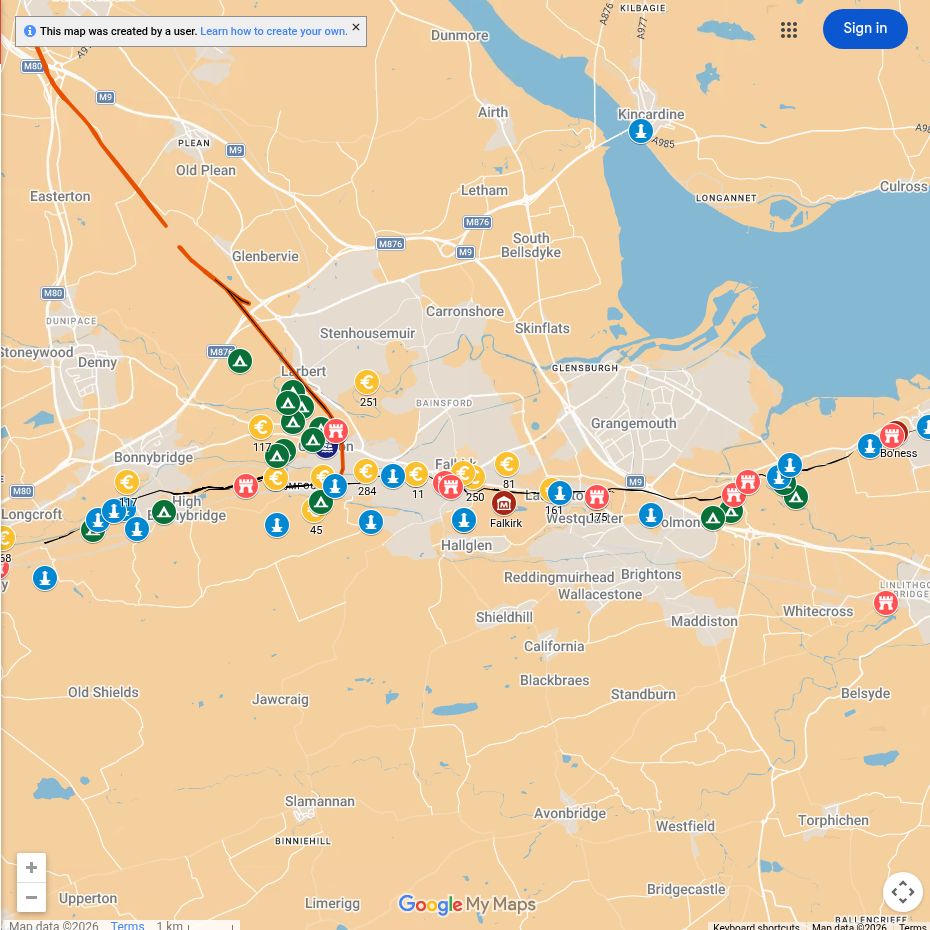
The surviving remains are spread across the modern town and its surroundings. Some are immediately recognisable, particularly the deep ditch and earthworks at Rough Castle and Watling Lodge. Others survive beneath streets, parks and fields. Taken together, they reveal that Roman Falkirk was not a single fort or settlement. It was an intensively used military landscape that changed repeatedly as Rome advanced, withdrew and returned.
Why was Falkirk important?
The Falkirk area occupies a natural route across central Scotland. From here, movement was possible westwards towards the Clyde, eastwards towards the Forth and northwards through the gap between the Campsie Fells and the Ochils.
Roman armies recognised the value of this position before the Antonine Wall existed. Forts and temporary camps were established around Camelon during the campaigns of the late first century AD. When the Antonine Wall was constructed from around AD 142, the district became part of Rome’s northern frontier.
The result was an unusually dense concentration of Roman installations. Forts at Rough Castle and Mumrills stood on the Wall, while Camelon remained an important military centre just to its south. Fortlets, roads, camps and signalling points connected these larger installations.
Rough Castle
Rough Castle, near Bonnybridge, is the best-preserved fort on the Antonine Wall and the best place to begin exploring Roman Falkirk.
Here it is possible to recognise the fort’s defences, its annexe, the Wall rampart, the great ditch and part of the Military Way. The site is especially famous for its lilia: rows of small pits positioned in front of the frontier. They may originally have held sharpened stakes concealed beneath light coverings.
Rough Castle was probably occupied by the Sixth Cohort of Nervians, an auxiliary regiment recruited originally in what is now Belgium. Inscriptions connect the unit with the fort, although the precise distribution of its soldiers between Rough Castle and neighbouring posts remains open to discussion.
Explore Rough Castle and other Roman forts in Scotland
Watling Lodge and the Wall
At Watling Lodge, near Tamfourhill, the Antonine Wall ditch survives on a monumental scale. This is one of the best places to appreciate the physical labour involved in constructing the frontier.
A fortlet once stood nearby, controlling a gateway through the Wall. Although little of it can now be seen, its location helps explain how movement through the frontier was supervised. The Wall was not simply an unbroken barrier. Gates, roads, forts and fortlets made it a managed military boundary.
Camelon
Camelon’s Roman history began before the Antonine Wall. A succession of forts, camps and associated structures occupied ground north of the modern Falkirk Wheel area.
The precise development of the complex remains debated, but Camelon was clearly a major military location. It stood close to important routes and probably supported Roman operations during more than one period of occupation. Much of the archaeology is no longer visible above ground, making excavation records and aerial evidence especially important.
Mumrills
Mumrills was the largest fort on the Antonine Wall. Its size suggests that it accommodated a substantial garrison and played an important role in controlling the eastern part of the frontier.
The fort has produced inscriptions, pottery, leather and other finds that illuminate the soldiers and communities associated with it. Modern development means that it is much less visually impressive than Rough Castle, but archaeologically it is one of the Wall’s most significant sites.
Search the inscriptions from Mumrills and other Scottish sites
What can you see today?
- Rough Castle: the clearest complete frontier experience, including fort, Wall, ditch, annexe and lilia.
- Watling Lodge: one of the most impressive surviving sections of the Antonine Wall ditch.
- Callendar Park: Roman interpretation and a convenient place to understand the Wall’s route through Falkirk.
- Camelon and Mumrills: important archaeological locations, although less survives visibly above ground.
If you have only two hours, combine Rough Castle with Watling Lodge. For a longer visit, add Callendar Park and use the wider Antonine Wall trail to follow the frontier through the town.

